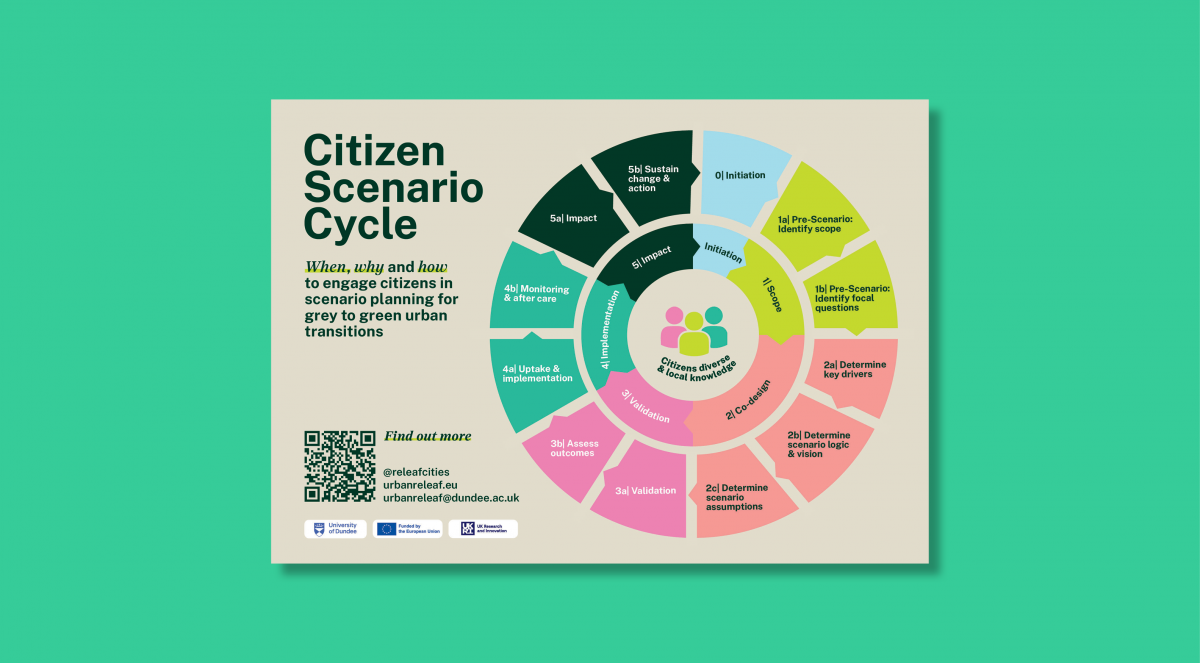
A new open-access study presents the first systematic review of how citizens are engaged in green-blue infrastructure scenario planning across European cities.
Despite growing interest in participatory approaches, the research finds that communities are still largely excluded from the moments that matter most. The paper, “Whose future? Citizens shaping green-blue infrastructure scenarios in European cities, a review and proposed framework” published in the leading journal Sustainable Cities and Society, also introduces a practical new framework designed to change this.
Urban ReLeaf explores how citizen science and citizen-generated knowledge and data can be integrated into authoritative datasets to strengthen Nature-Based Solutions (NBS) in urban planning, design, and decision-making. This research extends the project’s activity into urban design foresight and scenario planning, exploring the processes that set urban strategy and priorities in the first place. In doing so, it responds to a question that sits at the heart of Urban ReLeaf’s mission:
When cities plan greener futures, whose knowledge and visions actually shape them?
The challenge: planning for greener cities, but whose knowledge counts?
Green-blue infrastructure, which help cities adapt to climate change, is increasingly central to how European cities respond to climate and ecological challenges. Scenario planning is a widely used tools for envisioning what these urban futures could look like and how they can be achieved.
Yet while participatory approaches have grown in popularity across urban planning and research, it was unclear how, when, and to what degree citizens are genuinely involved in GBI scenario planning across European cities. This research set out fill that gap.
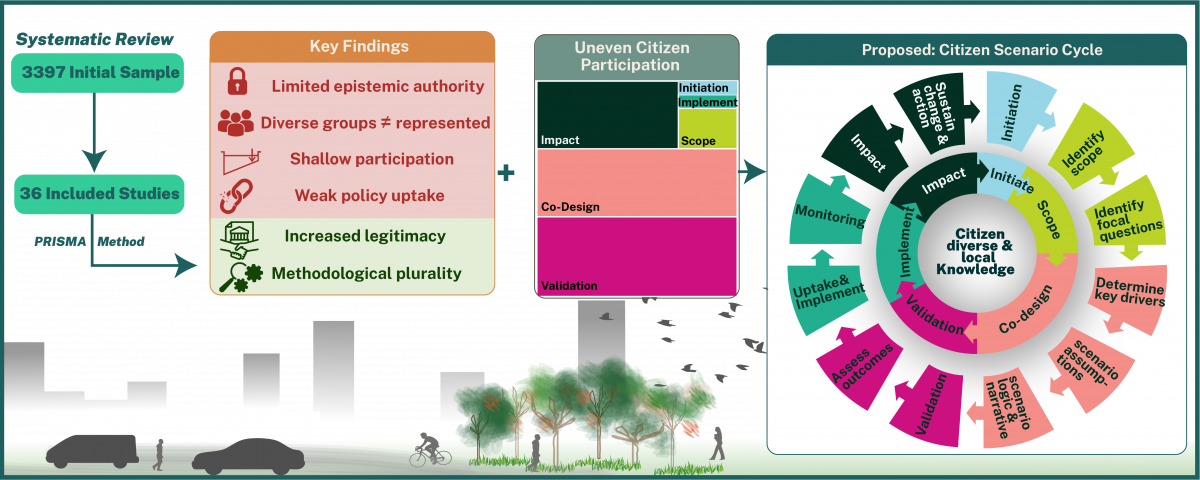
Following PRISMA systematic review guidelines, the authors screened over 2,800 publications before identifying 36 eligible studies spanning 25 European countries and more than a decade of research activity, from 2011 to 2025.
What the evidence shows
The results reveal a significant structural imbalance. Citizen participation in GBI scenario planning is not absent, but it is consistently uneven, and rarely extends to the stages where it may matter most.
Across the 36 studies, citizen involvement was most frequently concentrated in the design and validation stages of the scenario process: 17 studies engaged citizens in co-design activities and 20 at the validation stage, most commonly in the preference-ranking of pre-developed scenarios. The early agenda-setting stages where problems are framed, priorities are set, and the scenario boundaries are established remained almost entirely expert-led. Crucially, none of the included studies engaged citizens at the initiation or pre-scenario scoping stages.
In nearly all studies, citizens played contributory roles, for example providing data through surveys or citizen science tools or collaborative roles by feeding into expert-led processes. Only one of the 36 studies was classified as a genuinely co-created, with citizens holding real epistemic authority over the process.
There is also a clear gap between participation and impact. Fewer than a third of studies provided any evidence of their scenarios being taken up in policy, planning, or local action, raising important questions about whether participatory exercises, however well designed, are reaching the governance structures that determine what actually gets built.
At the same time, the evidence is clear that meaningful and sustained citizen inclusion adds real value. Studies consistently reported four categories of benefit: the integration of local and lived knowledge that would otherwise be absent; greater social legitimacy and community trust in planning outcomes; capacity building among participants and institutions; and more equitable, representative processes.
Introducing the Citizen Scenario Cycle
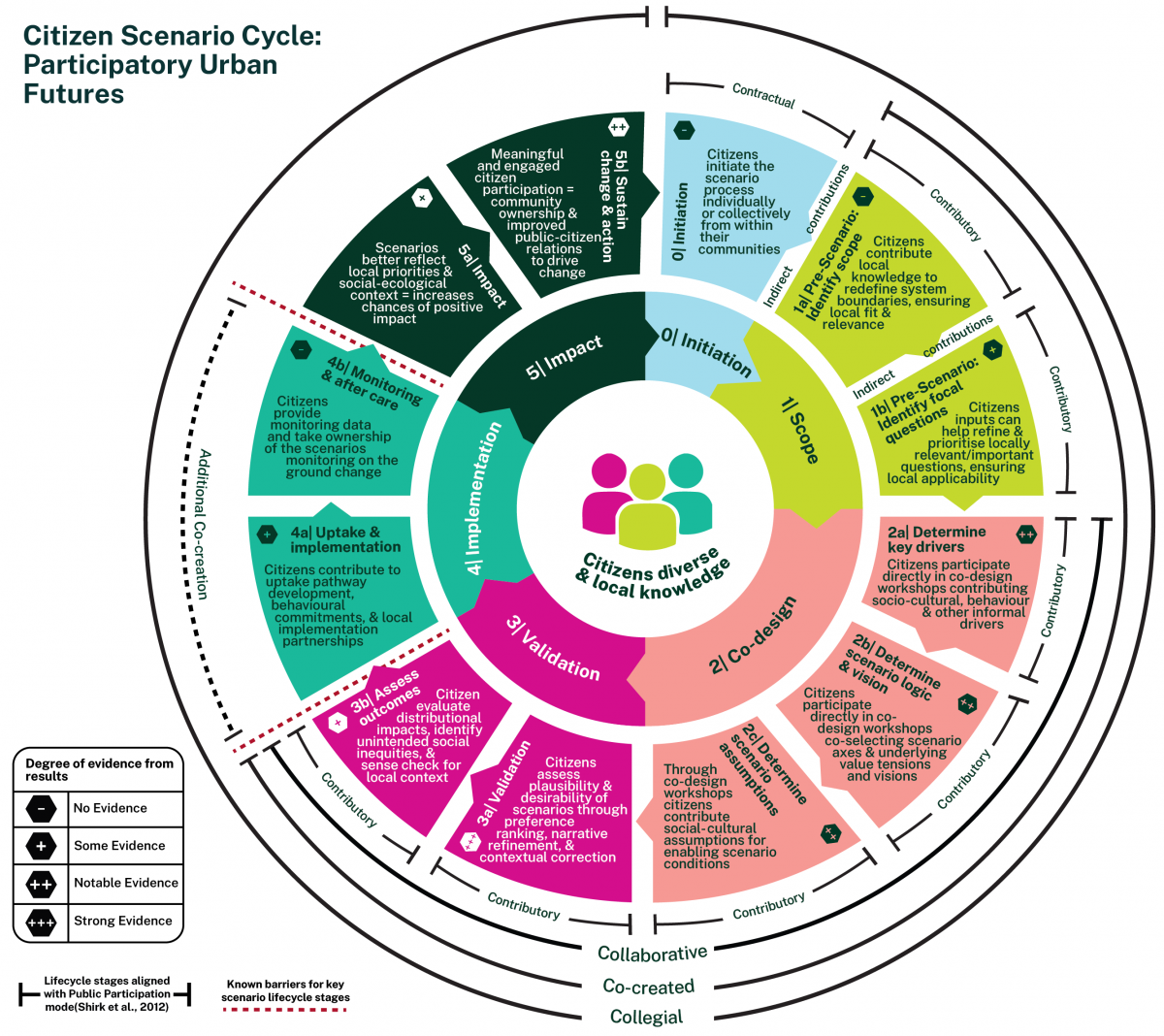
To address the persistent imbalances identified in the review, the paper presents the Citizen Scenario Cycle (CSC) – a novel framework designed to embed meaningful citizen participation across the full lifecycle of GBI scenario planning.
Spanning six stages from initiation to long-term impact, the CSC identifies specific opportunities for citizen involvement at each stage, including the mode of participation most appropriate to each stage; the particular knowledge and value that citizens can contribute; and providing reflective and evaluative questions to help practitioners assess whether participation is genuinely adding value.
Critically, the CSC is not a prescriptive checklist or a one-size-fits-all model. It is designed as a flexible, evidence-based structuring tool that acknowledges the diversity of contexts in which scenario planning takes place. What it challenges is the deeply embedded tendency for citizen involvement to remain an add or, or isolated aspect of scenario planning.
What this means for Urban ReLeaf
This research extends and complements Urban ReLeaf’s approach of co-creating green urban futures with communities across cities. The authors’ work on urban design foresight and scenario planning sits at the interface of research, practice, and policy. By establishing the state of knowledge on citizen participation in GBI scenarios and developing the Citizen Scenario Cycle as a practical tool, it strengthens the foundations on which Urban ReLeaf’s participatory planning activities are built, including how scenario planning can offer a meaningful way to act on data and citizen participation to compliment authoritative digital strategies and decision-making.
The Citizen Scenario Cycle is intended as a resource not only for researchers, but for municipal planners, community organisations, and policymakers working on nature-based solutions and climate adaptation across Europe and beyond. It offers practical support for those seeking to move beyond tokenistic engagement and embed community knowledge into long-term urban planning, ensuring that when cities envision greener futures, those futures belong to everyone.
The paper is published open access under a CC BY licence and is freely available to read, share, and use.
Read the full paper here: Kirby, M., Woods, M., Frediani, K., & AlWaer, H. (2026). Whose future? Citizens shaping green–blue infrastructure scenarios in European cities — a review and proposed framework. Sustainable Cities and Society, 149, 107732. DOI: https://doi.org/10.1016/j.scs.2026.107732